By 1049 Metropolitan Asset Properties
There is a version of this story that ends in fear.
The war escalated. Iranian missiles hit UAE soil. A stock index fell 21% in under two weeks. Expatriates paused. Family offices reconsidered. Headlines warned of bubbles and collapses and the end of Dubai’s decade-long run as the world’s favourite wealth destination.
That version of the story is incomplete.
Here is the full one — built on data, not sentiment — for the investor who moves with intention.
The Dubai Market You Need to Understand
Before the war, before the noise, there was context. And the context is staggering.
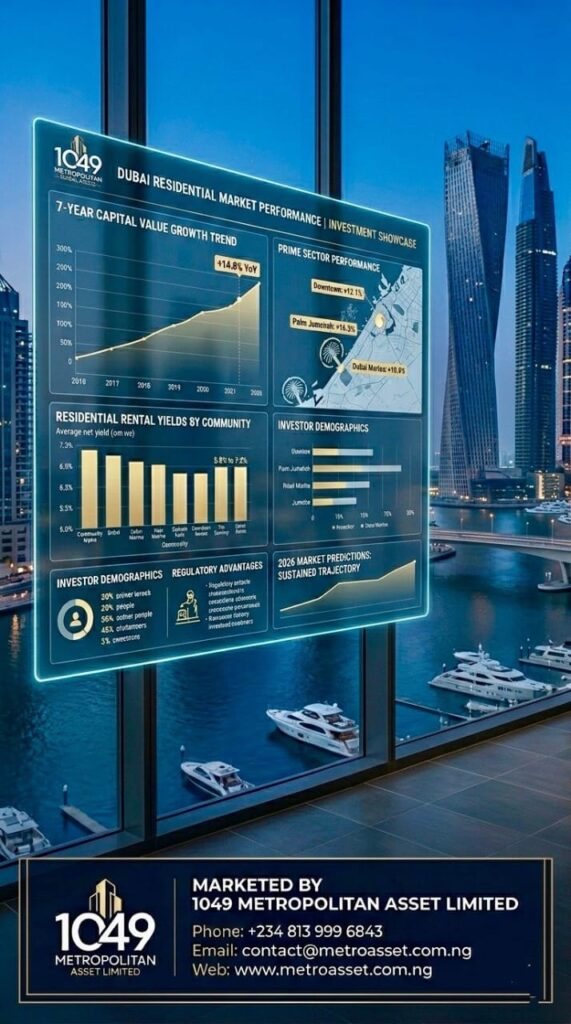
In 2025, Dubai’s real estate market recorded AED 917 billion ($250 billion) in total transactions — the highest annual volume in its history. Over 270,000 deals were closed. Residential prices were up 60–75% since 2021. More than 500 properties sold above $10 million — compared to just 30 in 2020. The city crossed 4 million residents, with 175,000–225,000 new arrivals projected every year through the decade.
This was not a speculative bubble. This was structural demand meeting a city that had, quietly and deliberately, made itself indispensable to global capital.
As Knight Frank’s Head of Residential for MENA put it: “The sustained momentum reflects the city’s evolution from a speculative real estate market to one characterised by genuine end-user demand, structural depth, and long-term investor confidence.”
January 2026 — the month before the conflict escalated — recorded the highest single-month property sales in Dubai’s history: AED 72.4 billion. The market was not fragile going into this storm. It was, arguably, the most well-capitalised it had ever been.
What the War Actually Did — And Didn’t Do
Let’s be precise, because precision is what serious investors deserve.
When the US–Israel–Iran conflict escalated in early 2026, and Iranian strikes directly affected the UAE, three things happened to Dubai’s real estate market
The DFM Real Estate Index fell ~21%. This is an equity index — it measures how listed developer companies (Emaar, Aldar, etc.) are trading on the stock market. It is not a measure of what your apartment in Business Bay or your villa in Dubai Hills is worth.
Transaction activity paused. Investors adopted a “wait-and-see” posture. Not an exit. A pause. The industry consensus puts this disruption at 48–72 hours for most active investors, with sentiment-driven slowdowns in the weeks following.
Luxury segment pressure intensified. Properties above $8 million — already showing slower absorption since late 2025 — faced additional headwinds. Construction activity, however, remained entirely unaffected across the emirate. Not a single project delay was directly linked to the conflict.
Every major financial institution currently on record — CBRE, ANAROCK, Citigroup, Nisus Finance — classified this as a **sentiment shock, not a structural collapse.**
CBRE’s Chairman for MENA said it plainly: “A temporary pause in investor activity” against a backdrop where “Dubai’s real estate fundamentals remain resilient.”
Now here is what the headlines missed entirely.
The conflict accelerated capital inflows from the very regions it disrupted.
High-net-worth wealth inflows into Dubai rose 46% year-on-year in 2025, with $63 billion arriving from conflict-affected jurisdictions — Iran, Israel, Lebanon, Russia, Ukraine. Capital fleeing political risk has exactly one destination in the Middle East: a dollar-pegged, rule-of-law, tax-free market with world-class infrastructure and transparent property rights. That market is Dubai.
The Iran conflict did not destroy Dubai’s safe-haven thesis. For HNW investors with exposure to unstable regions, it reinforced it.
How Dubai Protects Your Investment
One of the most persistent misconceptions about Dubai real estate — particularly among first-time international investors — is the idea that the market is loosely regulated, developer-driven, or difficult to navigate as a foreigner.
The opposite is true.
Dubai has built one of the most sophisticated investor protection architectures in the world, refined specifically from the lessons of the 2008 crisis when developers collected payments and abandoned projects. That will never happen again. Here is why:
RERA Escrow Protection. Under Law No. 8 of 2007, every dirham you pay for an off-plan property is deposited into a RERA-approved escrow account at a DLD-authorised bank. The developer cannot touch those funds until an independent inspector verifies construction milestones. If the developer goes bankrupt, your money does not enter the general bankruptcy estate — it is ring-fenced for project completion or investor refund. In 2025, RERA increased escrow monitoring by 35% and collected over AED 12 million in penalties from non-compliant firms.
DLD Title Deed Security. The Dubai Land Department registers every ownership record on a blockchain-backed digital ledger. Your title deed is tamper-proof, remotely verifiable via the REST app, and legally irrefutable. Ownership clarity in Dubai is, objectively, more robust than in most Western markets.
Freehold Rights for Foreign Nationals. Since Law No. 7 of 2006, foreign nationals have had full freehold ownership rights in over 30 designated zones — Dubai Marina, Downtown Dubai, Palm Jumeirah, Business Bay, JLT, and more. The 2025 regulations expanded and reaffirmed these rights. In April 2026, Dubai removed the minimum property value requirement for the two-year investor residency visa entirely — the most significant widening of access in the programme’s history.
Structural Defect Liability. Developers carry a 10-year liability for structural defects post-completion. One year for installations. These are not suggestions — they are enforceable legal obligations backed by RERA sanctions.
The Golden Visa. A property purchase of AED 2 million (~$544,500) now qualifies for a 10-year renewable UAE residency covering the investor, spouse, and children of any age. No minimum stay. No sponsor required. No points system. Processing in weeks, not years. As of 2026, off-plan properties qualify — you don’t need to pay the full amount upfront to secure your visa eligibility.
For an investor coming from a market where regulatory protections are thinner — where title documentation can be contested, where escrow is not mandatory, where developer accountability is inconsistent — Dubai’s architecture is not just reassuring. It is transformative.
Why Right Now Is the Strategic Entry Point
Markets reward disciplined entry. They punish reactive exit. And the current moment in Dubai’s property market is one of the most compelling post-disruption entry windows since COVID-19.
Here is the case, point by point.
Here is a sentiment discount on structurally sound assets. Equity markets down 21%; physical property fundamentals unchanged. This gap between perception and reality is temporary. It is also an arbitrage — and the investors who recognise it early will capture returns that those who waited for certainty will not.
Developer incentives are at a cyclical high. During the uncertainty window, B-grade and C-grade developers are offering direct discounts and more flexible payment plans than at any point in the 2023–2025 bull run. Even among premium developers, the negotiating position for off-plan buyers is materially better than at peak sentiment. You are now buying at terms you could not have accessed six months ago.
Rental yields are at global highs. Dubai’s gross rental yields of 6.7–11% across key communities are 2–3 times what equivalent assets yield in London (3–4%) or New York (3–4%). And unlike those cities, the yield is entirely tax-free. No income tax. No capital gains tax. No property tax. No inheritance tax — for individuals. The net yield story is not even close.
The population engine is structural, not cyclical.** Dubai adds 175,000–225,000 new residents every year — employment-driven, professional migration that creates demand for residential space year after year. The rental base expands automatically. Your vacancy risk decreases with every passing year.
For the Nigerian investor specifically: this is dollar-denominated wealth preservation.** The AED is pegged to the USD. A Dubai property is a real, hard dollar asset in a world where the naira devalues, dollar scarcity bites, and local real estate yields are eroding in real terms. Your rental income is dollar income. Your capital appreciation is dollar appreciation. Your sale proceeds are dollar proceeds. The cross-currency dimension of this investment, for the African HNW investor, may be its most important feature.
The recovery window is already opening. With the US–Iran ceasefire and stabilisation of tensions through April–May 2026, CBRE, ANAROCK, and Pangea Dubai are converging on the same conclusion: accumulated demand, a market that paused but did not collapse, and strong structural fundamentals point to a sharp rebound in transaction activity. The investors entering now are entering ahead of that rebound, not behind it.
Why 1049 Metropolitan Asset Properties Is Your Advisory Partner for Dubai
The Dubai real estate market is not a self-service market.
In a city where 270,000+ transactions happen annually, where off-plan and ready markets operate by fundamentally different rules, where geopolitical timing can be the margin between a great investment and an average one — the broker you choose is not a commodity decision. It is a strategy decision.
1049 Metropolitan Asset Properties brings two things to your Dubai investment that no portal or directory can replicate:
Deep client context. We understand the Nigerian and African HNW investor — your financial structures, your FX realities, your risk parameters, your goals around wealth preservation and generational transfer. We speak your language. We evaluate opportunities through your mandate, not through a developer’s commission schedule.
Advisory precision. We do not send you a list of listings. We build you an investment thesis — calibrated to whether your priority is yield, capital appreciation, Golden Visa access, portfolio diversification, or all of the above. Then we match that thesis to the right asset, the right developer, the right timing, and the right entry structure.
In a market recovering from a sentiment shock, where opportunity windows are measured in weeks not months, that precision is not a luxury. It is the investment itself.
The Bottom Line
Dubai’s real estate market is not collapsing. It paused.
The fundamentals — population growth, tax-free yields, dollar-pegged stability, world-class regulatory protection, global capital inflows — are intact. The sentiment shock is real but temporary. The recovery is already beginning. And the entry window created by geopolitical uncertainty is, for the disciplined investor, a rare gift.
The question is not whether Dubai is a good investment.
The question is whether you are positioned to take advantage of the moment before it closes.
1049 Metropolitan Asset Properties, in partnership with Dubai’s real estate market, is your pathway in.
Ready to explore a Dubai investment structured around your specific mandate? Reach out to 1049 Metropolitan Asset Properties for a confidential advisory consultation.
1049 Metropolitan Asset Limited | Lagos · Dubai
contact@metroasset.com.ng | metroasset.com.ng
Data sourced from Dubai Land Department (DLD), RERA, CBRE, Knight Frank, ANAROCK, Cavendish Maxwell, Engel & Völkers Dubai, Pangea Dubai, and Fitch Ratings. All figures current as of May 2026. This article is for informational purposes only and does not constitute investment advice.*